Choosing a Day Nursery in Corby
A practical guide to what to look for on a nursery tour, the questions to ask, and how to tell when a nursery in Corby is right for your child. Written by the team at Handprints Nurseries; honestly, whether you end up choosing us or not.
Choosing a nursery is one of the hardest, most emotional decisions you'll make as a parent. You're handing over the daily care of the most important person in your life to a room full of people you don't yet know. It's supposed to feel like a big deal; because it is.
This guide is written by the team at Handprints Nurseries in Corby, from years of showing round parents just like you. It isn't a sales pitch. It's the guide we wish we could hand every parent before their first tour of any nursery, ours or anyone else's; the questions to ask, the things to look for, the red flags to trust your gut on.
By the end you should have a proper mental checklist for your tours, know what a genuinely good nursery looks and feels like, and understand how funded hours actually work in Northamptonshire.
1. Start with the practicalities
Before you fall in love with any nursery, sanity-check the basics.
- Location. Is it on your commute or a proper detour? A five-minute daily wobble adds up. In Corby, most nurseries are within a mile of the centre; Weldon, Rockingham and Cottingham and the surrounding Northamptonshire villages are all within a short drive.
- Opening hours. Most Corby settings open somewhere between 7:00am and 8:00am and close between 6:00pm and 6:30pm. If your work day is longer than the nursery day, you'll be paying a childminder or grandparent to bridge the gap; factor that in early.
- Age groups. Not every nursery takes babies from six weeks; some start at 12 months or later. If you'll want the same setting for a sibling in a year or two, check now.
- Fees and funded hours. Get the honest number, including the weekly enrichment / consumables charge, meal costs, and any signup or holding fee. Ask about the difference between term-time-only and stretched funding; most nurseries in the area accept government funded hours; how they apply them varies. (Our own fees calculator walks through this for Handprints.)
2. On the tour; what to actually look for
Every nursery will show you a clean, well-set-up room. What separates the great ones from the merely fine is what happens in the background.
Watch the children, not the walls. Are they engaged? Absorbed in something? Or drifting? Bored, listless children are a signal; not always a red flag, but worth noticing.
Watch the staff. Are they at children's eye level? Following a child's lead or directing them? Do they know the children by name and know something specific about each one; a favourite song, a settling routine, a milestone? "Julia loves the sand tray" tells you more than any brochure.
Feel the atmosphere. A great nursery has an ambient hum; chatter, laughter, occasional crying that's being kindly attended to. Complete silence is odd. Chaos is worse. What you want is purposeful busyness.
Cleanliness without sterility. Everything should be clean, but a spotless, art-free, hushed room is a sign of a nursery being "put on show" rather than lived in. Real learning is messy.
Notice the physical space. Natural light, outdoor access, age-appropriate resources at child height, room to move without collision. Ask to see the outdoor space; a nursery that hides its garden usually has a reason.

3. Safeguarding; the non-negotiables
Every good nursery should be able to tell you, without hesitating:
- Who their Designated Safeguarding Lead is (and their deputy)
- That all staff are DBS-checked and reference-checked, with a documented Safer Recruitment policy
- The building's secure entry system and any CCTV coverage
- Their most recent Ofsted rating; and a copy of the report if you ask
- What happens if a concern is raised about a child, and how it's escalated
If any of these questions produce a pause, a vague answer, or a "we'll get back to you"; trust it. Safeguarding is the single most important thing a nursery does. Confidence on this topic should be immediate.
(You can read how safeguarding works at Handprints; including how each setting has its own on-site Designated Safeguarding Lead with group-level Director oversight.)
4. Understanding the learning approach
The Early Years Foundation Stage (EYFS) framework is the government standard every English nursery must follow. It sets out seven areas of learning and how children's progress should be tracked. Every nursery follows EYFS; how they interpret it is where nurseries differ.
Common approaches you'll hear about:
- Play-led / child-led; the adult follows the child's fascination and builds learning around it
- Reggio Emilia-inspired; the environment is treated as "the third teacher"; deep, weeks-long projects sparked by children's questions; heavy use of expressive materials
- Montessori; carefully prepared environment, self-directed activity, structured materials
- More formal / school-preparation focused; earlier introduction of phonics, structured group time, sit-down activities
None of these is objectively "best"; different children thrive in different setups. What matters is that the nursery can articulate its approach and show you how it plays out in a normal day. If a nursery can't tell you what they do differently from the setting down the road, that's a signal.
At Handprints Corby we run a Curiosity Approach-inspired, play-led practice within the EYFS framework; you can read more on our approach page or what a typical day looks like.

5. Meals and food
Ask two questions:
- Is food cooked on site, or brought in? Fresh, on-site cooking (with a real chef or cook, not just a member of staff heating up trays) is a marker of investment in the day.
- How are allergies and dietary needs handled? Every nursery should have a documented process. Ask specifically what happens on a day when your child's Key Person is off; how does the cover know?
Snacks and milk should be included in fees. Meals are often billed separately; ask for the per-meal cost and whether it changes with age. (Read how food works at Handprints.)
6. Communication; how you'll actually stay connected
The best nurseries feel like an extension of your family. That doesn't happen by accident; it happens through consistent communication.
Ask about:
- The parent app. Most modern nurseries in Corby use Famly or a similar platform; real-time photos, meals, naps, nappies, key milestones. Ask to see a screenshot of what you'd receive on a typical day.
- The Key Person system. Every child should be assigned one Key Person; a specific, named staff member who is their adult. Ask what the Key Person does at drop-off and pick-up, and how handovers work between staff. (Read how Handprints does Key Persons.)
- What happens if there's a concern. Small ("she's not eating today") and large ("she had a bump this afternoon"). You want to hear the specific process.
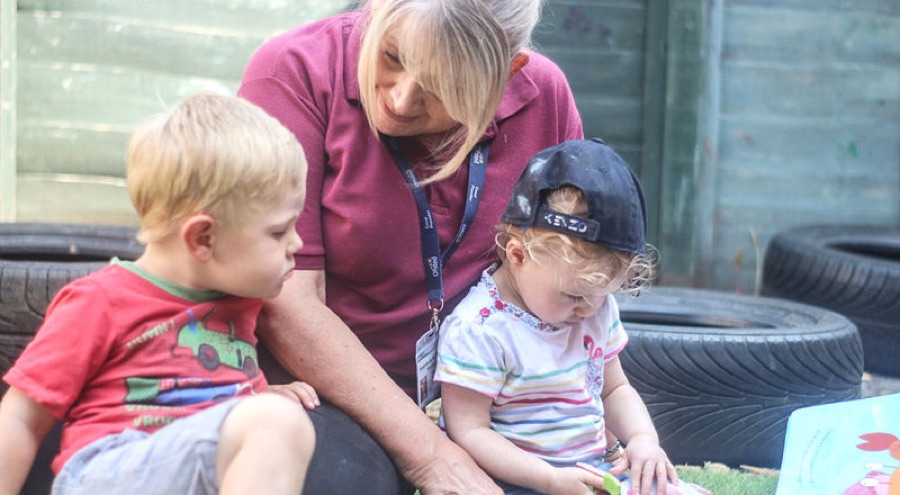
7. Settling in; what "good" looks like
A rushed settling process is a red flag. So is a rigid one-size-fits-all plan.
Good settling looks like:
- Multiple, gradually longer sessions before the official start date; typically 2–4, but flexed to your child
- Regular short updates from the Key Person during each session (photo message within 10–15 minutes of you leaving is a good standard)
- A pace that responds to your child; not a fixed programme
Ask what happens if your child is genuinely not settling. The honest answer isn't "they always settle"; it's "we'd contact you, and here's what we'd try together."
You can read how settling in works at Handprints as one example.
8. Government funded hours; the short version
Every 3–4 year old in England is entitled to 15 hours a week of government funded childcare during term time. 30 hours is available for eligible working families (both parents earning within the qualifying bracket, neither over the cap). 15 hours is also available for eligible 2-year-olds and, as of 2024–25, for eligible working parents of children as young as 9 months.
The government pays for 38 weeks a year (term time). Most nurseries offer two ways to take those hours:
- Term-time only; you get the full 15 or 30 hours a week, but only for 38 weeks. Holidays are billed at your normal rate.
- Stretched; the same total hours spread evenly across all 51 open weeks of the year. Your weekly funded hours are smaller (around 11 or 22 instead of 15 or 30), but your weekly bill is the same year-round.
Neither is "better"; it depends on whether you value consistent monthly budgeting or maximum term-time childcare. Ask each nursery which options they support and see our worked examples for how the maths lands.
You can check your own eligibility at childcarechoices.gov.uk.
9. Questions to ask on every tour
Copy-paste these twelve questions into your notes app before you visit any nursery in Corby:
- Who is the Designated Safeguarding Lead? Who's their deputy?
- What's your most recent Ofsted rating and when was your last inspection?
- What's the staff:child ratio in each room, and how do you cover for staff absence?
- What does a typical day look like for a child my child's age?
- How does the Key Person system work here? What happens if my child's Key Person leaves?
- What curriculum or approach do you follow, and how would I see it in a normal day?
- Are meals cooked on site? How are allergies handled?
- How do you handle settling in? What's your process if my child struggles?
- How will I know what my child has been doing today; app, email, verbal at pickup?
- What are your fees, per week, including everything (consumables, meals, enrichment)?
- Do you accept funded hours? Term-time only or stretched?
- What's your notice period, and do you have any signing-on or holding fees?
Come and see Handprints Corby
We're Handprints Nurseries; an Ofsted-registered day nursery on Rockingham Leisure Park just off Princewood Road, with plenty of parking. Independent, family-run, Curiosity Approach-inspired, all-year fresh meals cooked on site, dedicated Key Person for every child. If you're at the "starting to visit nurseries" stage, we'd love to be one of the ones you tour; even if we're not the one you end up choosing.

Jo runs our Corby nursery day-to-day and personally hosts most tours. Show-round tours are free, take about 30–45 minutes, and cover every room. Call us on 07787 22 8000 for a chat first, or book online.
Choosing a nursery in Corby; FAQs
Common questions from Corby parents in research mode.
For a September start, most families in Corby begin touring in the previous January–March. For babies, 6–9 months ahead of your ideal start date is normal; some nurseries have longer waiting lists for baby-room places specifically.
A day nursery is open all year (excluding bank holidays) and typically takes children from a few weeks old to school age. A preschool usually operates during school term times only and takes children from around 2 to school age. A childminder is a home-based, Ofsted-registered carer, often with a smaller group of children.
It means the setting has been inspected against a national standard and meets it in every category. It's a floor, not a ceiling; but a nursery without a "Good" rating (or a very recent inspection) deserves questions. You can look up any nursery's inspection report on reports.ofsted.gov.uk.
Genuinely, most children settle in 2–3 weeks; including many parents who were sure their child wouldn't. What matters is that the nursery has a plan for the small number that don't, and that they'll talk to you honestly rather than reassure you into worrying more. Ask what their process is.
Weekly fee alone isn't enough; the meal and enrichment charges vary a lot. Ask each nursery for a worked example of a typical week for your child's age and days pattern, all-inclusive. It's the only way to compare like-for-like.
Ready to see Handprints Corby?
Book a tour and we'll walk you through every room, answer every question on your checklist, and help you compare us honestly to any other nursery you're considering.